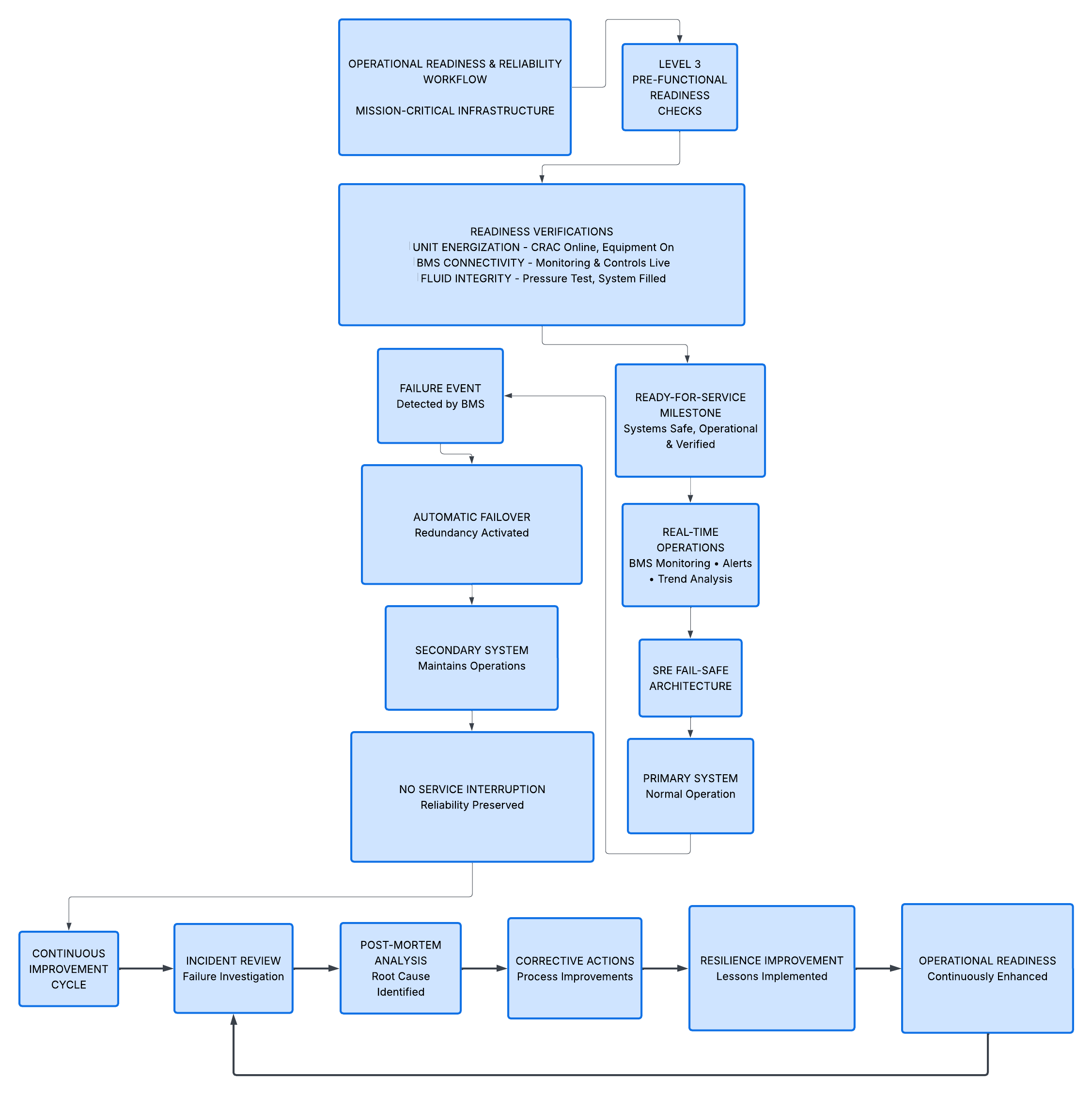
OPERATIONAL READINESS IN MISSION-CRITICAL INFRASTRUCTURE

Ensuring reliability through commissioning, testing, redundancy, and continuous operational improvement.

GREEN CALLOUTS: READY-FOR-SERVICE MILESTONES
Green callouts indicate Level 3 Pre-Functional and commissioning readiness stages. These milestones confirm that systems are safe, energized, and ready for operational use.
Key readiness checks include:
• Unit Energization: CRAC units and supporting systems are powered on and confirmed operational.
• BMS Connectivity: The Building Management System (BMS) is fully online and capable of monitoring and controlling environmental conditions in real time.
• Fluid Integrity: Chilled water systems are cleaned, pressure-tested, and filled according to commissioning standards.
BMS systems provide continuous monitoring and generate actionable alerts to support operational reliability and prevent silent system failures.

SRE & RELIABILITY PERSPECTIVE
From a Site Reliability Engineering (SRE) perspective, this architecture is designed to fail safely.
Any failure in one path automatically triggers redundancy activation in the secondary system, preventing downtime.

OPERATIONAL READINESS
Operational readiness includes not only system design but also post-incident learning. Every failure scenario should result in a post-mortem review process to prevent recurrence and improve system resilience.
This approach ensures reliability is continuously improved rather than assumed.